Hardware interface
Bead or flange must sit in the existing housing. A family photo is not that measurement.
BUYER SUPPORT / FIRST ORDER
Compare factory quotes on the same rubber diaphragm line
FREE review of product, quantity, destination and sourcing requirements
Eligible first orders may receive up to 3%
Eligibility applies to qualified business buyers and is confirmed after we review your product, quantity, destination, and sourcing requirements. Final figures depend on supplier confirmation, product type and order value. This is not a discount, lowest-price, or today-only offer.
Use this page to decide whether a quoted custom rubber diaphragm will actually interface with the existing equipment, and which compound and ASTM or equivalent detail decides compatibility rather than preference. The layout is a decision roadmap. It is not a carbon or ESG story and it is not a contraceptive or medical product page.
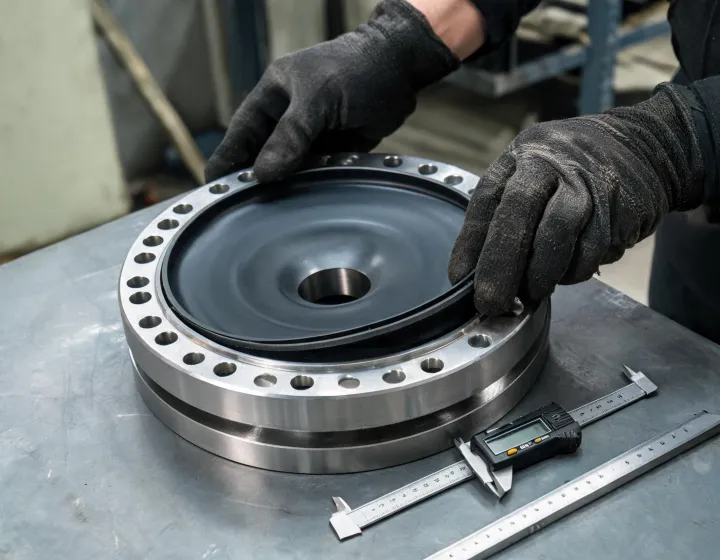
Record housing inner and outer seats or the drawing the factory must follow.
Name the fluid or gas. Preference for a familiar compound is not a compatibility result.
Write service °F or °C. A catalogue snippet is that factory’s claim for that line.
Keep the approved piece so a later production lot can be compared on the same axes.
Bead or flange must sit in the existing housing. A family photo is not that measurement.
Nitrile, FKM, silicone and EPDM are questions against the named fluid, not a preference list.
The method and the condition it was run under belong to the quoted grade. A plant ISO letter does not replace them.
An alternative custom rubber diaphragm is accepted only after the changed axes are written and re-issued.
Dimensional page, lot test, packing and Incoterms. Origin of melt or finishing when the receiving plant will ask.
Housing seats, medium, temperature, and whether a food-contact or REACH SVHC file is actually filed.
Same-basis list, visible substitutions, no invented compatibility chart and no percentage saving.
Rubber Diaphragm Sourcing does not stamp a media-resistance table as its own result.
What has to be verified before an alternative custom rubber diaphragm is accepted is the housing match, the compound against the medium, the temperature band and the document that names the quoted lot. Read the request checklist before the first factory email leaves.
Designers sometimes ask whether a thermoplastic elastomer can replace a vulcanized rubber diaphragm to cut cycle time. That is a real selection dispute, not a slogan. A TPE or TPU insert can be useful on a low-stroke, low-temperature cover that is over-molded onto a rigid housing. A transfer-pump or regulator membrane that sees compression set, tear, and continuous heat still usually stays on crosslinked NBR, EPDM, silicone or fluoroelastomer (FKM). This desk will write both options as separate lines. It will not convert a TPE quote into a drop-in for a vulcanized custom rubber diaphragm without the buyer restating Shore A, temperature in °F or °C, and the ASTM or equivalent method.
Compression set and tear strength belong on the factory document when the buyer asked. They are not published site ratings. A plant ISO 9001 letter does not replace a lot test. REACH SVHC or FDA 21 CFR 177 files stay attached to the named grade, not to Rubber Diaphragm Sourcing.
Write drawing or seats, compound ask, quantity and destination. Optional budget and supplier preference can travel with the requirement.
Request Factory Quotes